


The Great Reset: The State of M&A in the Short-Term Rental Industry
The Great Reset: The State of M&A in the Short-Term Rental Industry
As I walked the halls at VRMA International, I couldn’t help but feel a sense of déjà vu — a flashback to VRMA 2021. Once again, I met with more than a dozen eager buyers, all looking to accelerate growth through acquisitions. The energy felt familiar, but this time, it was grounded in discipline rather than froth.
Back in 2021 and 2022, the market was inflated by unprecedented factors — government stimulus, near-zero interest rates, and surging guest demand. Those days were a sugar high for the industry. The years that followed, however, tested everyone’s endurance. But now, after years in the wilderness, we’re seeing the beginnings of what I call “The Great Reset.”
The Past
From late 2022 through the end of 2024, the short-term rental industry faced a steady and humbling correction.
For property managers: supply exploded, demand plateaued, and operating costs rose sharply.
For acquirers: many had bought companies at peak performance — and at premium multiples. As churn increased and profits declined, focus shifted inward. Deals dried up. New entrants struggled to find an entry point in a volatile landscape.
Only a few strategic buyers made it through, and even they carry scars from that cycle.
The Present
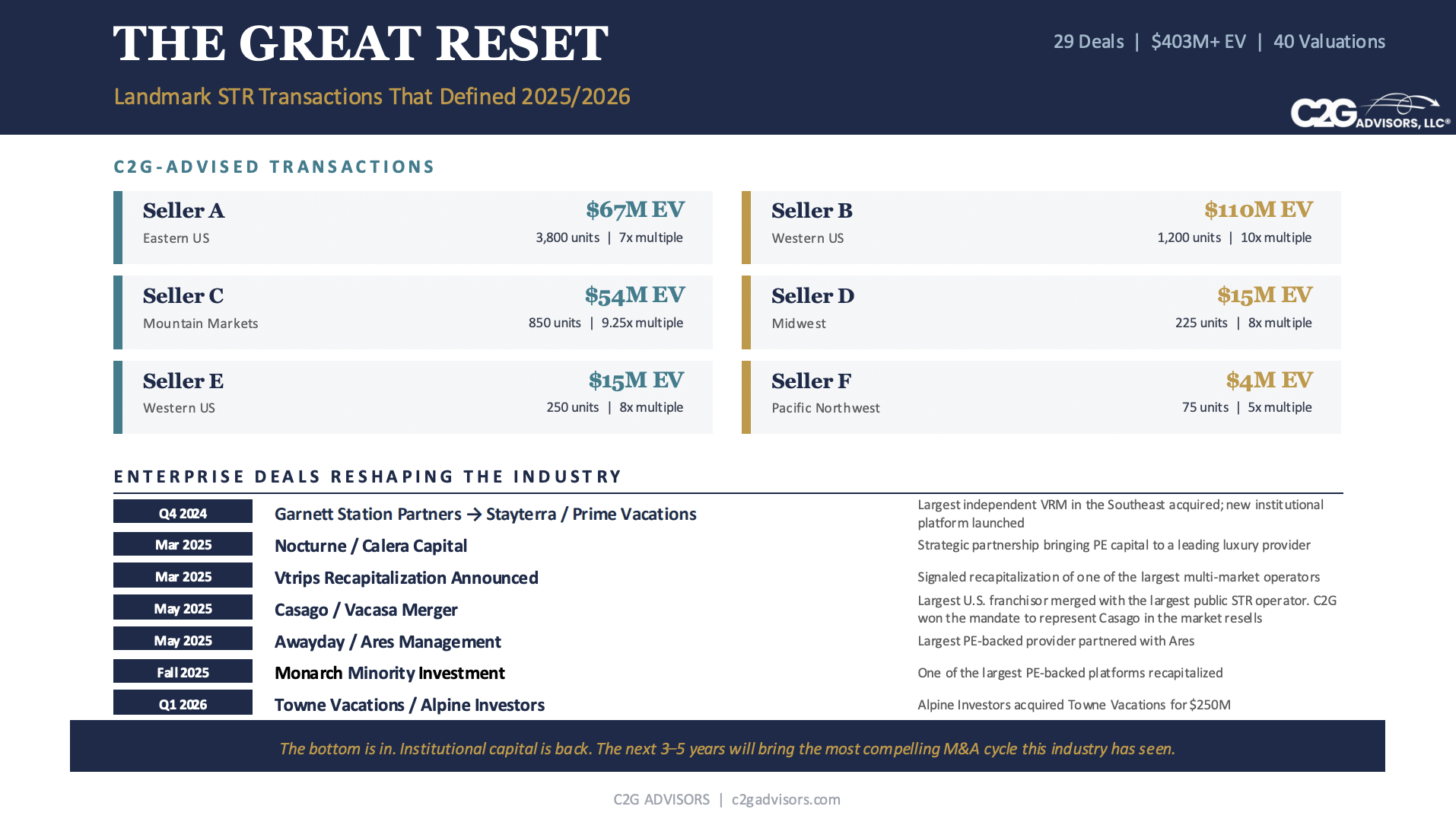
By late 2024, nearly five years after the pandemic began, something changed. Same-store bookings for 2025 began to stabilize. The overextended and opportunistic players had exited. What followed was a cascade of institutional moves unlike anything the industry had seen — all within six months:
- Q4 2024 — Garnett Station Partners launched StayTerra and acquired Prime Vacations, the largest independent vacation rental company in the Southeast.
- March 2025 — Nocturne announced a strategic partnership with Calera Capital.
- March 2025 — Vtrips signaled a recapitalization planned for late 2025.
- May 2025 — Casago, the largest U.S. franchisor, merged with Vacasa, the largest public operator.
- May 2025 — Awayday partnered with Ares for additional expansion.
- April 2026 — TowneBank sold Towne Vacations — a ~3,000-home luxury vacation rental management business spanning the Southeast — to a California-based private equity group for $250 million, in a deal the bank described as “too good to turn down.”
And behind the headlines? Another dozen or so sizable transactions, still completely confidential.
For a deeper look at the shifts driving this next chapter — the data, the players, and what it means for operators — download our State of the STR Industry report.
What This Means
Each of these transactions injected fresh institutional capital and long-term accountability into the space. But unlike the 2021 wave, this resurgence isn’t built on cheap debt or pandemic-era euphoria. These are more disciplined, thesis-driven investments.
Each acquirer now faces a mandate to 3–5x their investment in the next few years — which means the race is back on.
Dozens of groups that finished second or third in those prior processes are still out there — capitalized, motivated, and actively searching for their initial platform.
For sellers, this is a pivotal window: the next 3–5 years will bring a renewed cycle of strategic, profitable M&A activity. Buyers are sharper, data-driven, and value-focused, but they’re also more competitive with one another.
The Future
While no one has a crystal ball, absent major macro events, the next phase looks bright.
Short-term rental managers who continue to grow, professionalize their operations, and achieve $1M+ in EBITDA will hold meaningful leverage.
Scarcity and quality will drive premiums. The strong operators who’ve weathered the storm and built resilient, capable platforms will have their pick of buyers or partners.
The market has matured. The players have, too.
Let the next chapter begin.
About C2G Advisors
C2G Advisors is the leading M&A advisory firm in the short-term rental industry. We specialize in representing vacation rental management companies in mergers, acquisitions, and strategic partnerships, with completed transactions ranging from $1M to $100M+.
Our deep industry expertise and highly tailored approach allows us to work closely with founders and operators to identify the right strategic fit, run competitive processes, and ensure smooth transitions that prioritize long-term value, legacy, and stewardship.
