


How to Increase the Value of Your Short-Term Rental Business
How to Increase the Value of Your Short-Term Rental Business
In this article you’ll learn proactive steps you can take today to elevate your business for tomorrow. Whether you are looking for guidance with industry best practices or may be interested in selling your short-term rental business at some point in the future, implementing these items will guide your company to becoming a market leader.
A company’s value is determined by a combination of quantitative data (EBITDA, revenues, unit count, etc.) and qualitative data (brand, culture, reviews, etc.). Below we’ll touch on incremental changes that can have exponential effects. Measuring and tracking key performance indicators (KPIs), optimizing operations, and assembling consistent financial reports are paramount for maximizing the value of a short-term rental business.
Company Trends
It seems like everything is about data nowadays. However, data means nothing if you don’t know how to read it. The saying “garbage in, garbage out” is also true if you are not consistent in your reporting and tracking. By tracking the metrics and KPIs below, you can identify areas where you can improve your business and ultimately increase its value.
Unit Count
Managed inventory is a major data point. Since unit count fluctuates for short-term rental management companies, tracking these trends can quickly identify growth areas as well as potential concerns — such as whether your company has a “leaky bucket.”
A simple way to analyze unit count data is to keep a monthly units gained and lost spreadsheet. Always note the source of new units and the reason for each unit churned. Reasons for homeowner churn allow the company to spot issues and implement solutions fast. While it might seem obvious, even some of the largest players in the industry struggle to track their units gained and lost.
The average annual churn rate is 8–10%. Reach out if you’d like a template spreadsheet.
Advanced Pacing
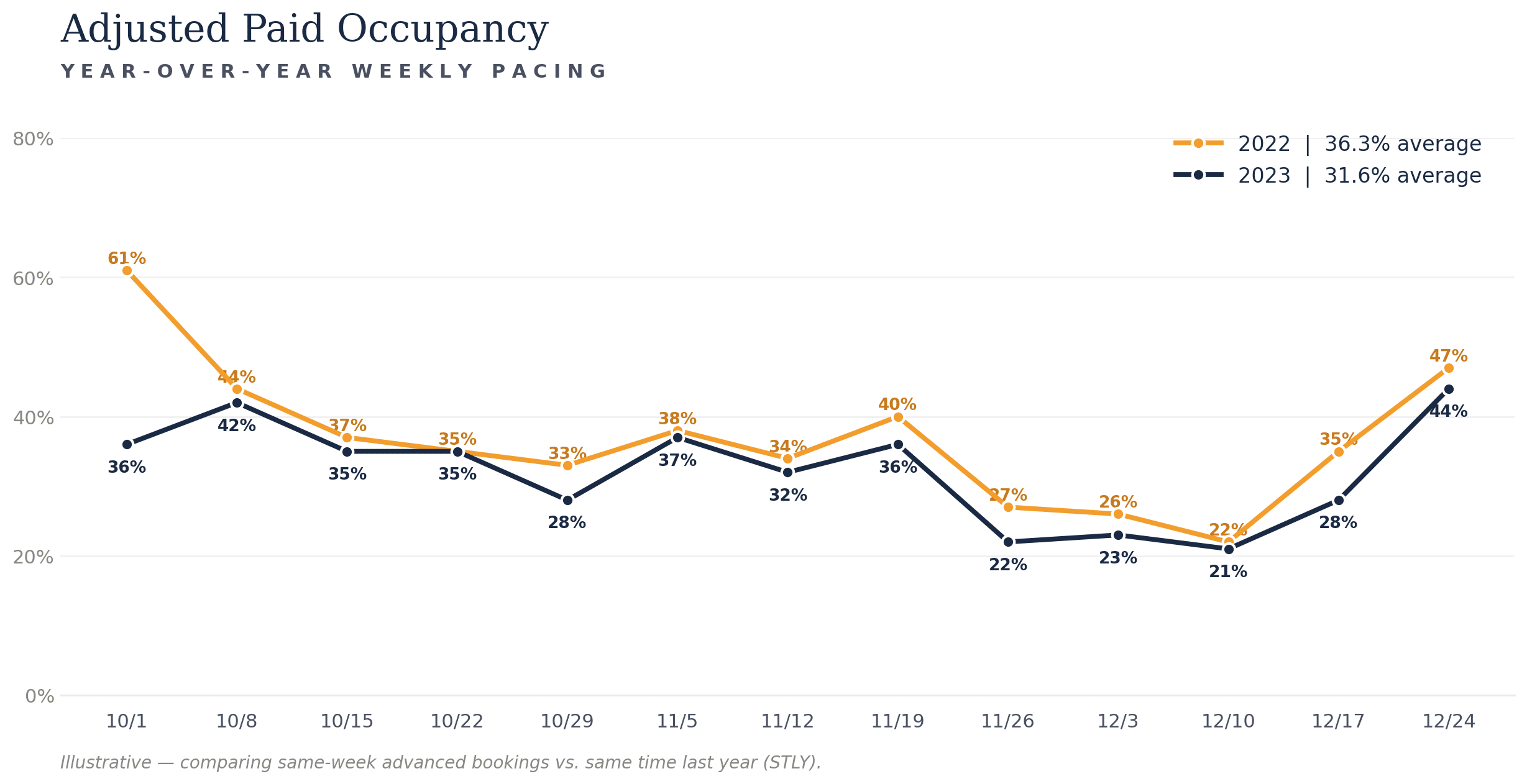
Our industry is unique in that we get a glimpse into the future. Additionally, we can compare current advanced booking metrics versus the same time last year (STLY). In doing so, we can see how the company is pacing and target specific areas to be further examined.
On a high level, STR business owners can track overall company financial health. Revenue managers can evaluate this data by segmenting into unit cohorts and even by individual unit (by bedroom, unit type, building, neighborhood, market, etc.). For example: if pool-front condos are booking up faster than courtyard-facing condos, it might be wise to tick up ADRs on the pool-front units. The only way to know this information is if these KPIs are being tracked.
Another example: in April, a homeowner notices that their rental home has no summer reservations yet. They’re concerned because last year at this time they had a full calendar. Breaking down advanced data into legible pieces will give you ammunition to discuss solutions or educate them on current market conditions.
Macro-wise, most companies are down YoY in aggregate advanced bookings due to occupancy decreases. However, as we move further away from the Covid bump, we’re seeing slightly positive signs of a “bottoming out” in YoY trends.
Check out this KeyData article on how booking windows are affecting the short-term rental market.
Take Rate
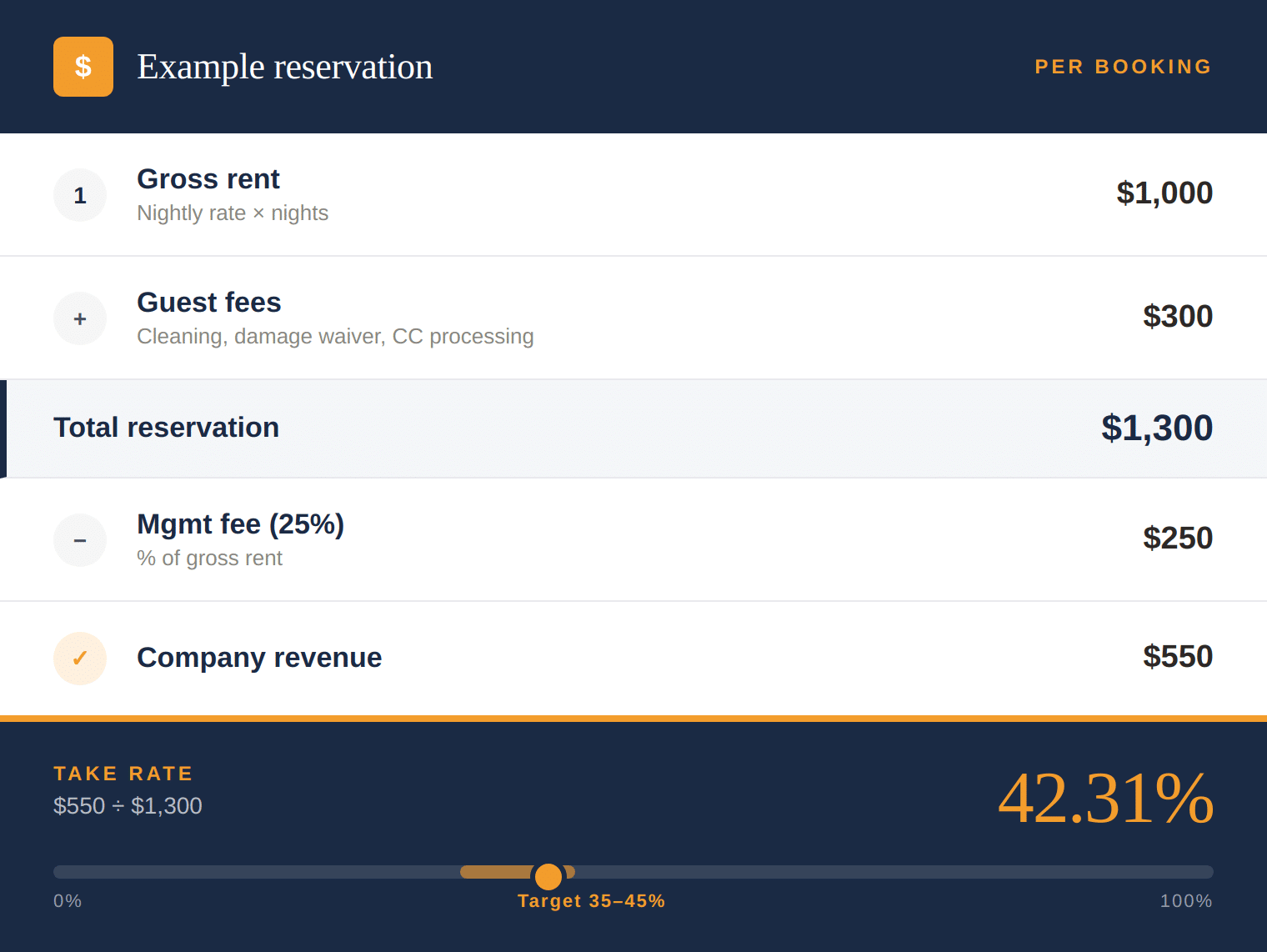
Another way to increase the value of your business is to diversify your revenue streams. This means charging for additional services, such as cleaning fees or damage insurance. These ancillary fees will contribute significantly to your vacation rental profit margin. A company’s take rate is the amount of revenue generated from the gross booking value. This metric is an important data point for analyzing the diversification of revenue. Unless your management fee is 40%–50%, it’s difficult to maintain profitability with only one source of revenue. The revenue from ancillary fees is generally almost equal to your management fee revenue (this is market-specific and varies based on urban vs. leisure).
Many vacation rental companies consider the homeowner as their primary client. Your market has a finite number of homeowners, but a nearly infinite amount of guests. If you’re going to err on the side of ancillary fees toward a customer, it’s generally best to lean toward guest-facing fees.
Study the market and do a little “secret shopping” of your competitors. Keeping track of this annually keeps you competitive:
- What percentage management fee do they charge?
- What does their homeowner rental contract look like?
- What additional reservation fees do they charge (per property type, static vs. dynamic, length of stay, etc.)?
The average take rate is 35%–45%, or slightly less than 2x your commissions. Reach out if you’d like a template competitor-analysis spreadsheet.
Operations
Short-term rental management is an operationally intensive industry. With multiple staffing departments each having specific software and communication needs, operations can quickly obscure the vision of the business. There are steps a business owner can take to get out of the “weeds” and lead the company’s mission. Operational efficiency is key to saving both time and money, leading to an increase in your vacation rental profit margin.
Technology Stack
Technology is rapidly evolving in our industry, and it’s easy to get caught chasing the next shiny toy. This can overload and even silo the staff. However, there are certain key software tools that are imperative for seamless operations and communication between staff, guests, and homeowners. Most, if not all, of your software should be integrated into your PMS along with unified inboxes. Jumping from software to software defeats the purpose of technology. If you’re wondering what best-in-class tools to use, talk with your property manager peers, not just vendors.
Check out Wheelhouse’s software vendor landscape.
Brand
Your company brand encompasses your guest-facing image, homeowner identity, and employee culture. Having a strong, cohesive brand unites your overall vision and ignites a sense of loyalty among clients and staff. Eventually, upon a sale, a strong company brand will bring more value to your company. This can be measured in direct bookings, reviews, NPS score, churn rates, Google Analytics, and more.
Staff
The short-term vacation rental industry is a labor-intensive operation with payroll being the largest expense. There are inflection points every couple of years in your business’s journey where the choice is whether to remain stagnant, sell, or invest in the future. If your answer is to invest, then you’ll take a step back in the short term (financially) to take a leap forward for the long term. Most vacation rental companies are small to medium-sized businesses (SMBs) and the company owners are normally intimately involved. However, a business is more valuable if the owner is in a leadership role. The most valuable delegated positions are the general operations manager and the homeowner liaison. It’s a critical growth initiative for the business owner to take a step back from those roles.
The average industry payroll margin is 20% for companies with outsourced cleaners and 40% for companies with in-house cleaners.
Financials
Is it really all about the money? Yes — yes, it is. It’s vital to have clear and precise financial statements that can easily tell the story of the business. If an advisor or investor needs a dynamic decoding device to decipher your financials, then it’s time to make a change. Legible financials bring immediate value now and in the future.
COGS
Cost of Goods Sold is an often-overlooked accounting section in the vacation rental industry. Recording direct costs of revenue allows for immediate and easy gross profit margin analysis. Each revenue account has direct costs, such as Processing Fee Income / Processing Fee Expense, Cleaning Fee Income / Cleaning Fee Expense, and Maintenance Income / Maintenance Expense. COGS is an integral category on your profit and loss statements.
Know Your Margins
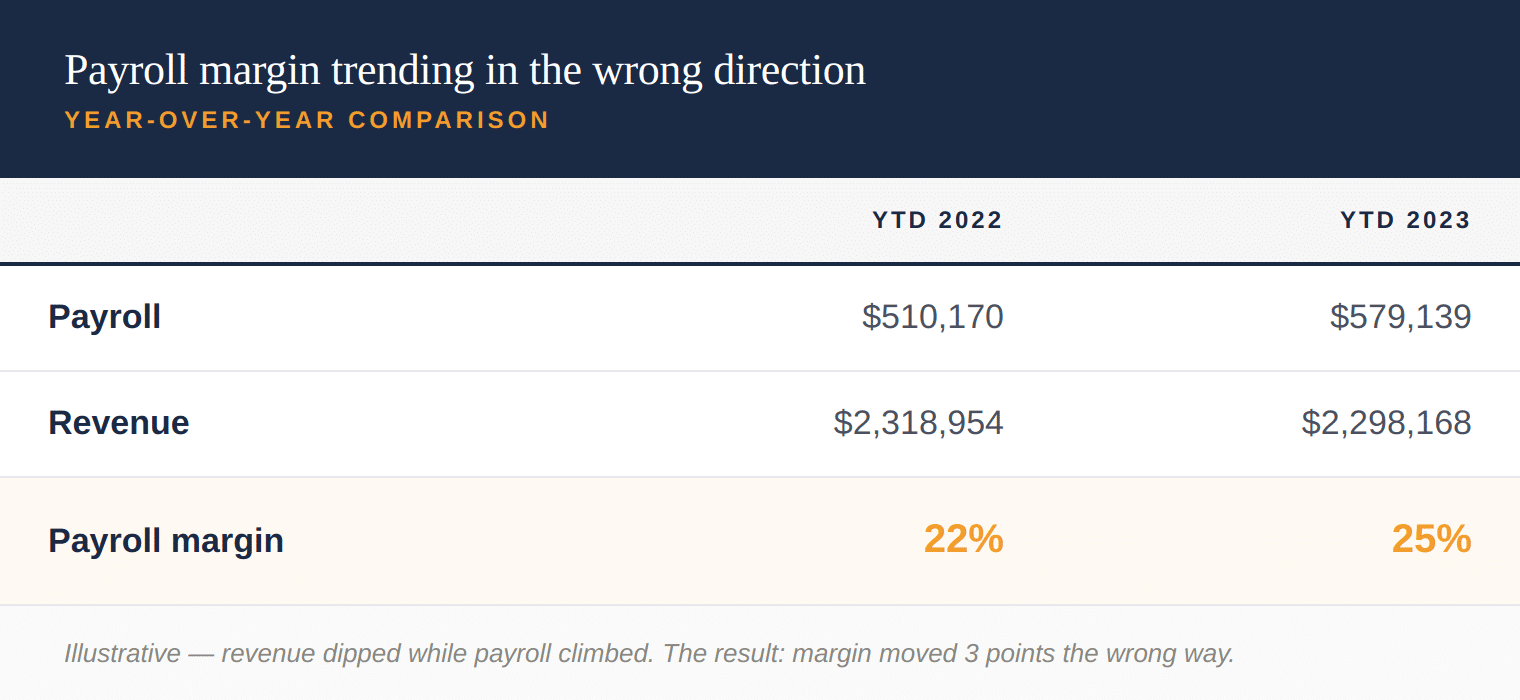
Everyone loves to look at profit margin, but profits are simply the result of revenues minus expenses. As noted above, COGS are a clear path to review direct cost margins of revenue. These margins are only beneficial if they’re consistently reviewed monthly, quarterly, and annually. If you’re reviewing June numbers in December, the opportunity to make necessary changes has passed and money has been left on the table.
There are many valuable margins for a company to track. Key margins should be tracked for your major expenses against company revenue.
Company revenue is management fee income plus all guest and homeowner fee income. The homeowner’s portion of rent is not company revenue and should not be on your P&L.
Financial-Based Decisions
Most businesses exist to make money. A healthy business is a profitable business, and a profitable business is valuable. Reviewing monthly financials immediately following the preceding month is crucial to making financial-based decisions. If you’re losing money on processing fees for every booking, it’s likely time to reevaluate how that revenue is generated. If your payroll margins are increasing, you may want to review the efficiencies between departments. The only way to truly know your company’s financial health is to timely track your margins.
Make sure your chart of accounts is set up properly in order to understand margins. There are great accounting firms we’re happy to recommend.
Ultimately, there are countless other criteria that can increase the value of your short-term rental business — quality of inventory, homeowner longevity, diverse revenue streams, direct booking percentage, SEO rankings, and more. Depending on the nuances of your business, some metrics are more easily attained than others. When growing your business, it’s advantageous to track clear and precise data points, whether financial KPIs, booking metrics, or operational synergies. These insights can contribute to enhancing your vacation rental profit margin and overall business value.
Want to Talk Through Your Numbers?
Whether you’re benchmarking against the industry, working through operational changes, or starting to think about an eventual sale, the work you do today directly shapes what your business is worth tomorrow. Reach out to C2G Advisors for a confidential conversation about where you are and where you want to go.
