


6 Steps to Successfully Sell Your Vacation Rental Business
6 Steps to Successfully Sell Your Vacation Rental Business
Selling a short-term vacation rental business is no small decision. It’s a process that combines the complexity of a multi-month due diligence period with the nuance of numerous moving pieces. However, the acquisition process can be more streamlined when armed with the right knowledge. Whether you’re considering retirement, shifting your career focus, or would just like to cash in on your investment, here are six steps on how to sell a vacation rental management business successfully.
1. Consult with Advisors
M&A Consultant
An experienced M&A consultant can add enormous value to your business sale. They will analyze the approximate value of your business, identify potential obstacles, discuss the challenges and opportunities you’ll face as a seller, find well-capitalized buyers, and negotiate all business terms in your best interest. With years of transactional experience, industry M&A advisors also give insights into industry trends and factors that could affect the sale.
As the leading vacation rental M&A firm in the industry, C2G Advisors is fully prepared to support you in selling your business whenever the time is right.
Attorney
An attorney can make or break a deal. Be wary of hiring an attorney that does not have transactional experience. Many times, your M&A consultant can recommend one.
CPA
Talk with your CPA on how you will be taxed based on the structure (asset vs. stock), timing, terms, and the purchase price allocation.
Wealth Advisor
Whether you are retiring or shifting careers, talk with an expert on what to do with the money after an M&A consultant evaluates your business.
All in all, a good short-term rental advisory firm will tell you if and when your vacation rental business is ready to sell based on your goals. They will give you the good, the bad, and the ugly, and hold your hand throughout every stage of the multi-month process.
To learn more about the ins and outs of selling your business, check out our article on the Mergers & Acquisitions process.
2. Get Your Financials in Order
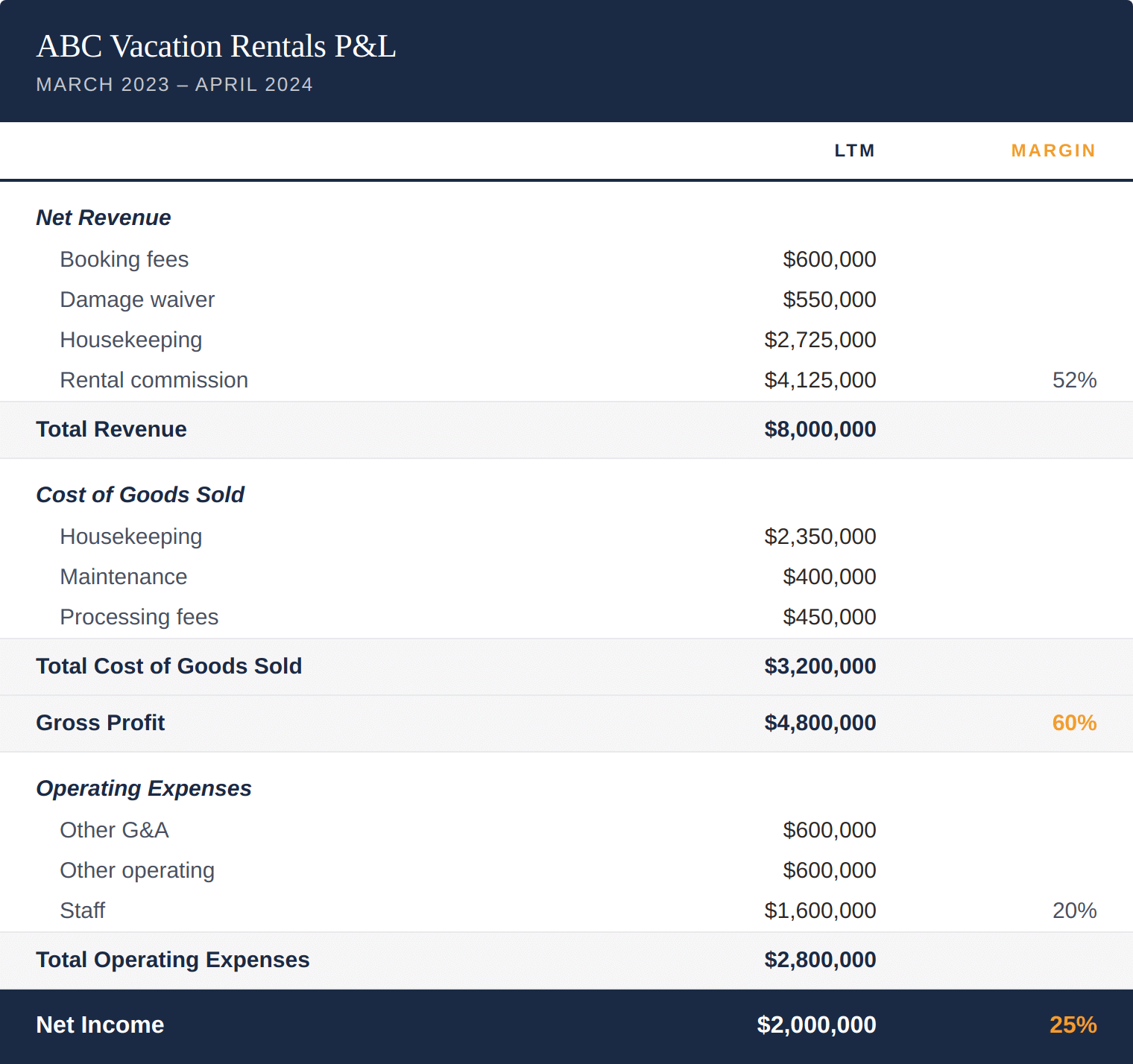
Buyers will want to see your prior three years of income statements and balance sheets. You should track and measure these on a monthly basis. It is also helpful to create a list explaining the various revenue and cost of goods sold (COGS) line items, so buyers can understand how your vacation rental business financially operates. If you have any one-time outliers or unique expenses, talk with your accountant or bookkeeper to further grasp what they are. Understanding the financial hygiene of your short-term rental company prior to the sales process is paramount.
Pro tip: The sooner you start on steps 1 and 2, the better outcome you will have when selling your business.
3. Set Realistic Goals for the Sale of Your STR Business
We’ll be the first to say it: selling a vacation property management business is not an easy process. Therefore, don’t waste your time and energy if you haven’t reached your goals. Your goals should reflect the actual value of your business in today’s market.
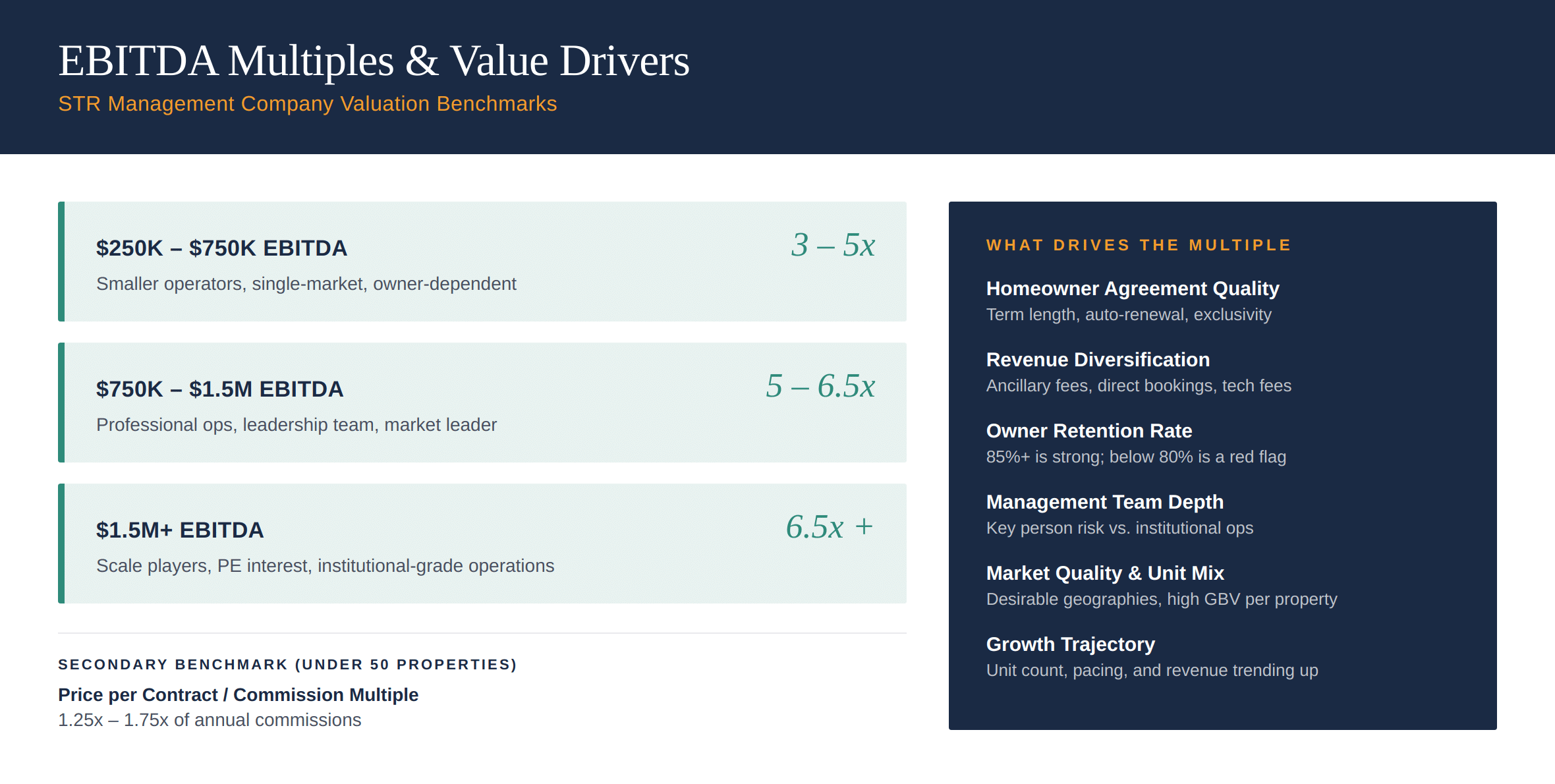
Most STR management company valuations come down to a multiple of Adjusted EBITDA, and where you land depends on size and operational maturity. Smaller, owner-dependent operators in the $250K–$750K EBITDA range typically trade at 3–5x. Companies in the $750K–$1.5M range — with professional operations and a real leadership team — see 5–6.5x. Scale players above $1.5M EBITDA, particularly those drawing institutional and private equity interest, can command 6.5x and higher. Companies under 50 properties are usually valued differently: 1.25x–1.75x of annual commissions, sometimes called a “price per contract” multiple.
But the size tier only sets the range — what determines whether you land at the top or bottom of it are the qualitative factors: homeowner agreement quality, revenue diversification, owner retention rate, management team depth, market quality, and growth trajectory. Two companies with identical EBITDA can sell for very different prices based on these drivers.
If you want to exit at a $5M purchase price but you’re currently doing $500K in last-12-months EBITDA, that’s a “back of napkin” value of roughly $2M — much less than your goal. There are things you can do to increase the value of your business, but it’s imperative to have realistic goals prior to going to market.
4. Review Your Short-Term Rental Contracts
Homeowner contracts are key assets of your vacation rental business — make sure they’re transferable or assignable. Prior to selling your business, you’ll need to review all of your contracts to make sure the language is adequate, not just a template contract.
Asset Purchase
Approximately half of the business transactions we see are asset purchases, meaning that a buyer is buying the assets of your company — not the actual legal entity. An asset deal will require that all your management contracts are assignable without the consent of the homeowner. There are other key clauses to review, but this is critical to allow you to transfer your contracts to a buyer. Without this language in place, buyers may require the contracts to convert at closing. This creates more friction in the process and could decrease the total proceeds of the sale.
Membership Interest Purchase
In a membership interest purchase (or stock deal), the buyer will acquire your legal entity and all the assets it encompasses. Assignment language is typically not required for this type of sale; however, there are some “change of control” provisions that may apply.
Another point of concern is homeowner concentration. It is a risk if one homeowner owns a large percentage of your inventory. This will give buyers hesitation, and there will be contingencies placed on the purchase price.
Read more about desired language in management contracts.
5. Research Potential Buyers
Vacation rental company buyers typically require seller assistance throughout a transition period. You’ll be trusting them with your company’s brand, employees, homeowners, and some portion of the deferred purchase price. It’s important to understand the different industry buyers to find the right partner for your business moving forward.
Current buyers range from regional strategics to national venture-capital-backed firms to large and small private equity. Each buyer has specific parameters for their target acquisitions, and they have a go-forward plan regarding company brand, staff, potential rollover equity, and business owner involvement post-close. Depending on what’s important to you, there are many different components to consider when heading toward an exit.
Review more about the types of buyers in this article.
6. Execute, Execute, Execute
Build your business to fit your goals, hire an M&A advisor, prepare your company to sell, market the business, review offers, negotiate, work tirelessly during due diligence, negotiate more, sign the closing documents, and finally — receive your money. Congratulations, you sold your business.
The acquisition process can be arduous, especially while you’re concurrently managing your business. After the deal closes, there is a typical transition period for the seller to assist the buyer. While the deal may have closed, most transactions have some amount of “holdback” payments that are contingent on post-closing targets. In the interest of both parties, it’s vital to work together to make the experience seamless for homeowners, employees, and vendors.
Ready to Take the Next Step?
Selling your vacation rental management business can be a joyous experience, but it’s not an easy task. Having an experienced team on your side — one that knows the complexities of selling a vacation rental management company — can make all the difference. Reach out to C2G Advisors for a confidential conversation about where you are and what your exit could look like.
