


Business Valuations 101: How Vacation Rental Companies Are Valued
One of the most frequent questions we get is, “What’s my vacation rental company worth?” The answer isn’t always straightforward — but the business valuation methods used in the industry are. Let’s break down the two main valuation methods we use to figure out the value of a vacation rental business: the Adjusted EBITDA method and the Price Per Contract method.
The Multiple of Adjusted EBITDA Method
EBITDA might sound like complex financial jargon, but it’s actually pretty straightforward. EBITDA is an acronym for Earnings Before Interest, Taxes, Depreciation, and Amortization. Essentially, it’s your net income with irregular or non-recurring costs added back to it. These adjustments make EBITDA a reliable metric for understanding the core profitability of your business without the noise of one-time transactions or unusual expenses.
This method determines your business value based on your company’s Last Twelve Months (LTM) Adjusted EBITDA.
How to Arrive at Your Adjusted EBITDA
To understand this valuation method, it helps to understand how you get to Adjusted EBITDA. Below is a P&L (Profit and Loss) statement for an imaginary vacation rental company, ABC Vacation Rentals.
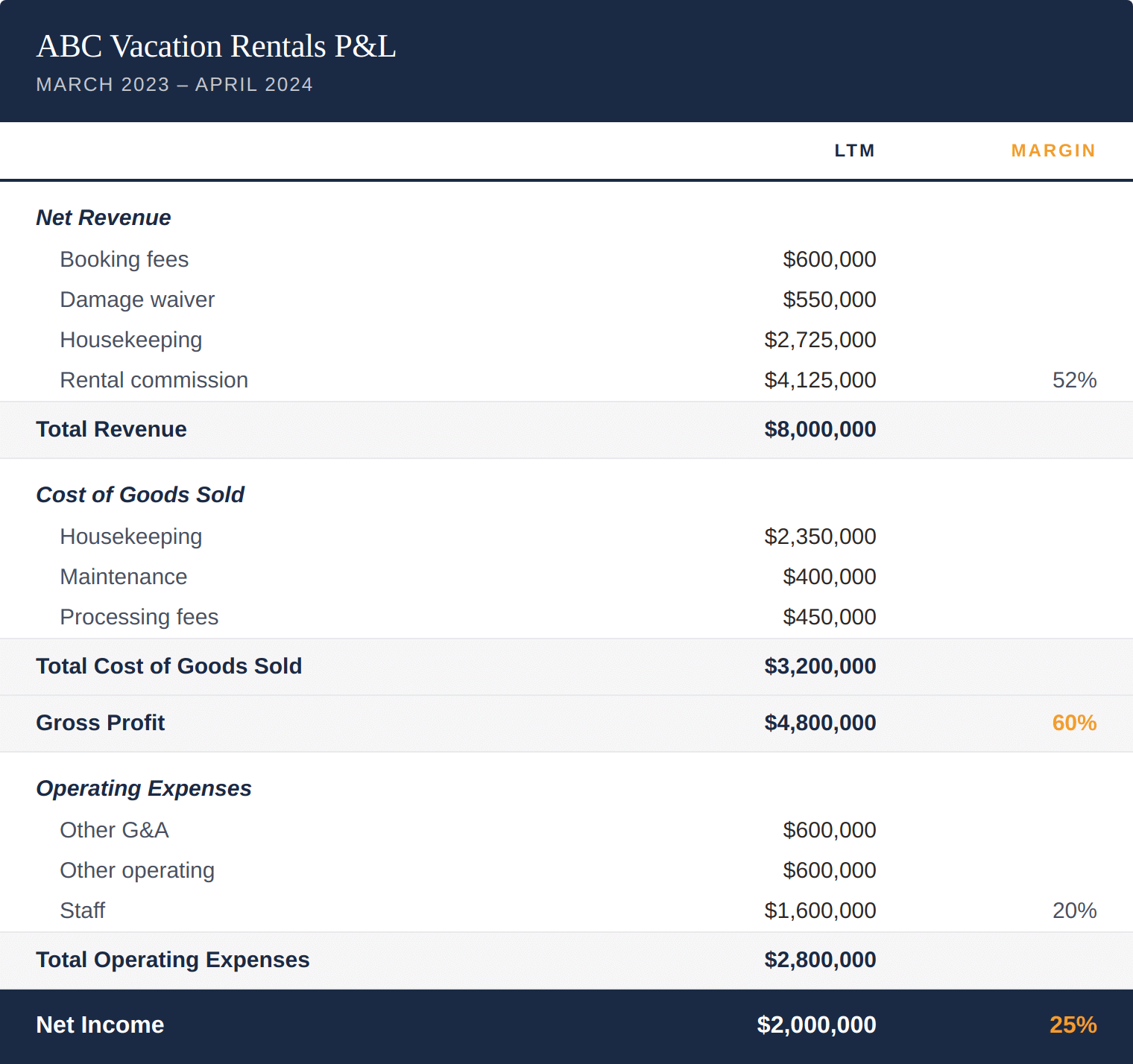
The P&L above lists all the streams of revenue for this company (booking fees, cleaning fees, etc.) to come up with Total Revenue. Below total revenue, the P&L lists the Cost of Goods Sold (COGS) — the expenses directly tied to each revenue stream. For instance, the cost of hiring a cleaning crew is a direct expense related to the cleaning fees charged by your company. By subtracting the direct costs from your earnings, we get Gross Profit.
Below Gross Profit on the P&L, you’ll find a section listing all other costs, which includes expenses not directly tied to revenue streams, such as salaries and office supplies. By subtracting these operating costs from Gross Profit, we arrive at Net Income — the total earnings of the company.
To dive deeper into key performance metrics like COGS, check out our article on increasing the value of your vacation business.
EBITDA Add-backs & Deductions
From here, we adjust Net Income by removing unusual expenses called add-backs — one-time or non-recurring business expenses that don’t reflect regular operations. Common examples include legal fees from a one-off lawsuit, one-time consulting costs, or owner-related expenses (personal travel, vehicles) that wouldn’t transfer to a new owner.
Similarly, it’s crucial to account for typical business expenses that may not have been initially included in the P&L, such as a market-rate salary for the owner. If the owner pays themselves below market — or nothing at all — a buyer will need to deduct that cost going forward, so it gets normalized into the financials now. Interest income, personal travel, and other items that flatter the bottom line without representing the actual operating reality of the business also get deducted.
By normalizing the P&L this way, we arrive at the Adjusted EBITDA. Most buyers will want to see three years of historical financials alongside the LTM (last twelve months), with LTM being the figure used to apply the valuation multiple.
Valuation Multiples
Here’s the fun part. Based on your Adjusted EBITDA — combined with the qualitative factors that determine where you land in the range — a multiple gets applied to arrive at your purchase price.
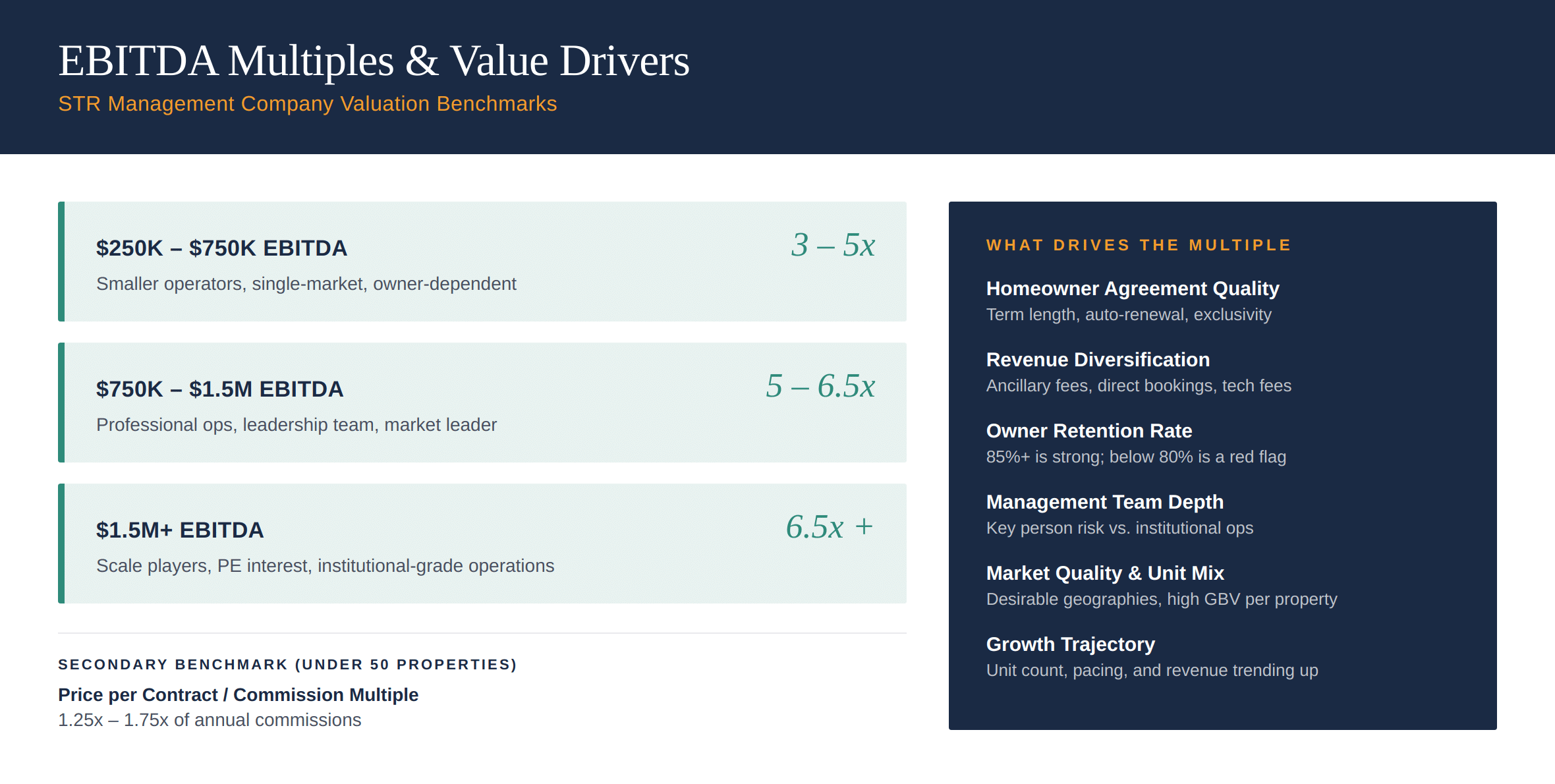
Smaller, owner-dependent operators in the $250K–$750K EBITDA range typically trade at 3–5x. Companies in the $750K–$1.5M range — with professional operations and a real leadership team — see 5–6.5x. Scale players above $1.5M EBITDA, particularly those drawing institutional and private equity interest, can command 6.5x and higher.
The size tier sets the range, but what determines whether you land at the top or bottom of it are the qualitative drivers: homeowner agreement quality, revenue diversification, owner retention rate, management team depth, market quality and unit mix, and growth trajectory. Two companies with identical EBITDA can sell for very different prices based on these factors.
Price Per Contract Method
The Price Per Contract method is the second valuation method used in our industry. This approach is less structured than the multiple of Adjusted EBITDA method and is typically reserved for smaller or less profitable companies. If your Adjusted EBITDA is less than $250,000, you’re likely looking at this valuation method.
What Are the Multiples for This Method?
With this method, you’re typically looking at a 1.25x–1.75x multiple of your company’s annual commissions. As a simple example, if your company generates $100,000 in annual commissions, applying that multiple would imply a potential sale price between $125,000 and $175,000, depending on factors such as contract quality, owner involvement, and operational complexity.
In most cases, transactions at this level are structured as asset purchases rather than the sale of the legal business entity itself. The primary asset being acquired is typically the homeowner management contracts, which are then rolled into the buyer’s existing platform and operating model. Because these contracts are absorbed into an established business with its own systems, staff, and overhead, the seller’s historical profit and loss statements tend to play a less central role than they would in a traditional standalone acquisition.
While the homeowner contracts are the core asset, buyers will often also assume or maintain additional intangible assets such as the company’s brand name, website domain, phone numbers, and other intellectual property — particularly when continuity helps preserve owner relationships and retention. The value in these transactions lies less in past profitability and more in the quality, transferability, and durability of the contracted revenue being added to the buyer’s existing operation.
Curious What Your Business Is Worth?
Understanding business valuation can be tricky, but you don’t have to do it alone. Whether you’re working with LTM Adjusted EBITDA or the Price Per Contract method, these are the standards for assessing value in the short-term rental industry — and the nuances behind them often determine where you actually land. Reach out to C2G Advisors for a confidential conversation about what your vacation rental business could be worth in today’s market.
